
The professional landscape of 2026 has undergone a seismic shift. If the early 2020s were defined by the “digital transformation,” 2026 is defined by “algorithmic efficiency.” For years, the term “soft skills” was reserved exclusively for interpersonal abilities—communication, empathy, and leadership. However, as Artificial Intelligence (AI) and Machine Learning (ML) have become embedded in every corporate department from HR to Marketing, a new hybrid skill set has emerged.
Scripting and automation are no longer the exclusive domain of software engineers; they are the new soft skills required for the modern workforce to remain agile, creative, and productive.
The Evolution of the “Soft Skill”
Historically, soft skills were defined as non-technical traits that determine how you work. But in a world where data is the primary currency, the ability to manipulate that data without waiting for a technical lead is a form of empowerment. This shift represents the “democratization of technical agency.”
As businesses in the United States and Canada strive for leaner operations, employees who can write a simple Python script to scrape market data or use Zapier to automate a multi-stage workflow are seeing significantly higher salary growth compared to their non-technical peers. This technical literacy facilitates better communication between departments, fulfilling the very definition of a “soft skill.” For students struggling to bridge this gap between theory and technical execution, seeking programming homework help has become a strategic move to master these essential competencies before entering the job market.
Why 2026 is the Tipping Point
According to the World Economic Forum’s 2025 Future of Jobs Report, analytical thinking and technological literacy remain the top priorities for global employers. By 2026, the “average” office worker is expected to manage at least three different AI agents.
1. Reclaiming Creative Time
Automation is the antidote to “burnout culture.” By automating repetitive tasks—such as data entry, email sorting, or report generation—professionals reclaim roughly 12 to 15 hours per week. This time is then redirected toward high-level strategy and creative problem-solving, which are the traditional soft skills that AI cannot yet replicate.
2. The Democratization of Code
With the rise of low-code and no-code platforms, the barrier to entry has vanished. Knowing how a “For Loop” works or understanding JSON-LD schema is now as fundamental as knowing how to format a Word document was in 2005. The modern professional doesn’t need to build the software; they need to know how to “talk” to it.
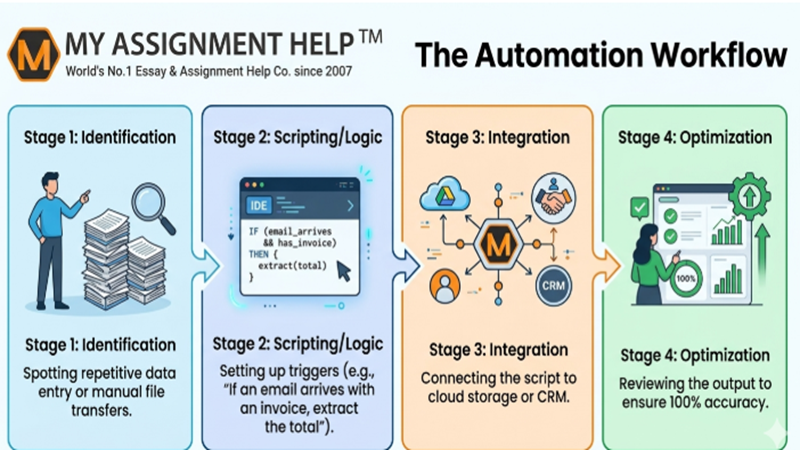
Data-Driven Impact: Automation by the Numbers
Recent studies from McKinsey Global Institute suggest that by late 2026, up to 45% of work activities can be automated by adapting currently demonstrated technologies. This isn’t just about robots in factories; it’s about scripts in spreadsheets.
- Marketing: Automated lead scoring and personalized email sequencing increase sales productivity by an average of 14.5%.
- Finance: Scripted audits and automated reconciliation reduce human error by 37% and cut closing times by half.
- Education: Personalized AI learning paths improve student retention rates by 22% by identifying gaps in understanding before they become failures.
For those entering complex fields like data science, web development, or engineering, the pressure to perform is immense. Often, the best way to stay ahead and ensure your foundational code is solid is to do my assignment with the help of experts who understand the nuances of 2026’s academic and industry standards.
The Psychological Advantage of the “Automation Mindset”
Beyond the hard numbers, there is a psychological shift. Professionals who understand automation approach problems differently. Instead of asking “How do I do this?”, they ask “How can this be done once and repeated forever?”
This mindset reduces cognitive load. When you aren’t bogged down by the “drudgery” of administrative tasks, your emotional intelligence (EQ) actually increases. You have more patience for team collaboration, more mental energy for complex negotiations, and a higher capacity for empathy—the very “soft skills” that define leadership.
Strategic Implementation: How to Build the Skill
To treat automation as a soft skill, one must adopt a specific mental framework:
- Identify the Friction: If you have to do a task more than three times, it is a candidate for automation.
- Audit the Workflow: Map out the steps of a process manually before looking for a tool. Logic must precede the script.
- Iterative Learning: Start with “If This Then That” (IFTTT) logic or Power Automate before moving to Python or Bash scripting.
Key Takeaways
- Hybridity is King: The most valuable employees in 2026 are “translators” who possess both high EQ and basic technical scripting skills.
- Efficiency = Empathy: By automating your own workflows, you respect the time of your team and stakeholders.
- Future-Proofing: Scripting is the new literacy. In the North American job market, it is becoming a standard requirement for “non-technical” roles.
Frequently Asked Questions (FAQs)
Q: Do I need a Computer Science degree to learn automation?
A: Absolutely not. Most modern automation involves “logic-based” thinking. Learning basic Python or using no-code tools like Zapier or Power Automate is accessible to professionals in any field.
Q: Will automation replace my job by 2026?
A: Automation is more likely to replace tasks, not jobs. Professionals who treat automation as a soft skill will find themselves in higher demand to manage and audit these automated systems.
Q: What is the best language to start with for office automation?
A: Python is the gold standard due to its readable syntax and massive library of automation scripts for Excel, PDFs, and web browsers.
Q: Is automation expensive for small businesses?
A: No. Many automation tools offer “freemium” tiers, and custom scripts written in open-source languages like Python are free to run.
About the Author: Angelika S.
Senior Academic Consultant & Strategic Advisor at MyAssignmentHelp Angelika is an expert in the digital transformation of higher education with over a decade of experience in curriculum development and technical writing. Specializing in the intersection of AI and career readiness, she helps students and professionals navigate the complexities of the modern workforce through data-driven insights and practical skill acquisition.
References & Sources:
- World Economic Forum (2025). The Future of Jobs Report: The Rise of the Citizen Developer.
- McKinsey Global Institute (2024). Generative AI and the future of work in America.
- Harvard Business Review (2025). Why Every Employee Needs to be a Technical Translator.
- Gartner (2026). Strategic Technology Trends: Hyperautomation in Local Government and Enterprise.